
Small Claims Court Filing and Hearing Checklist
From original sources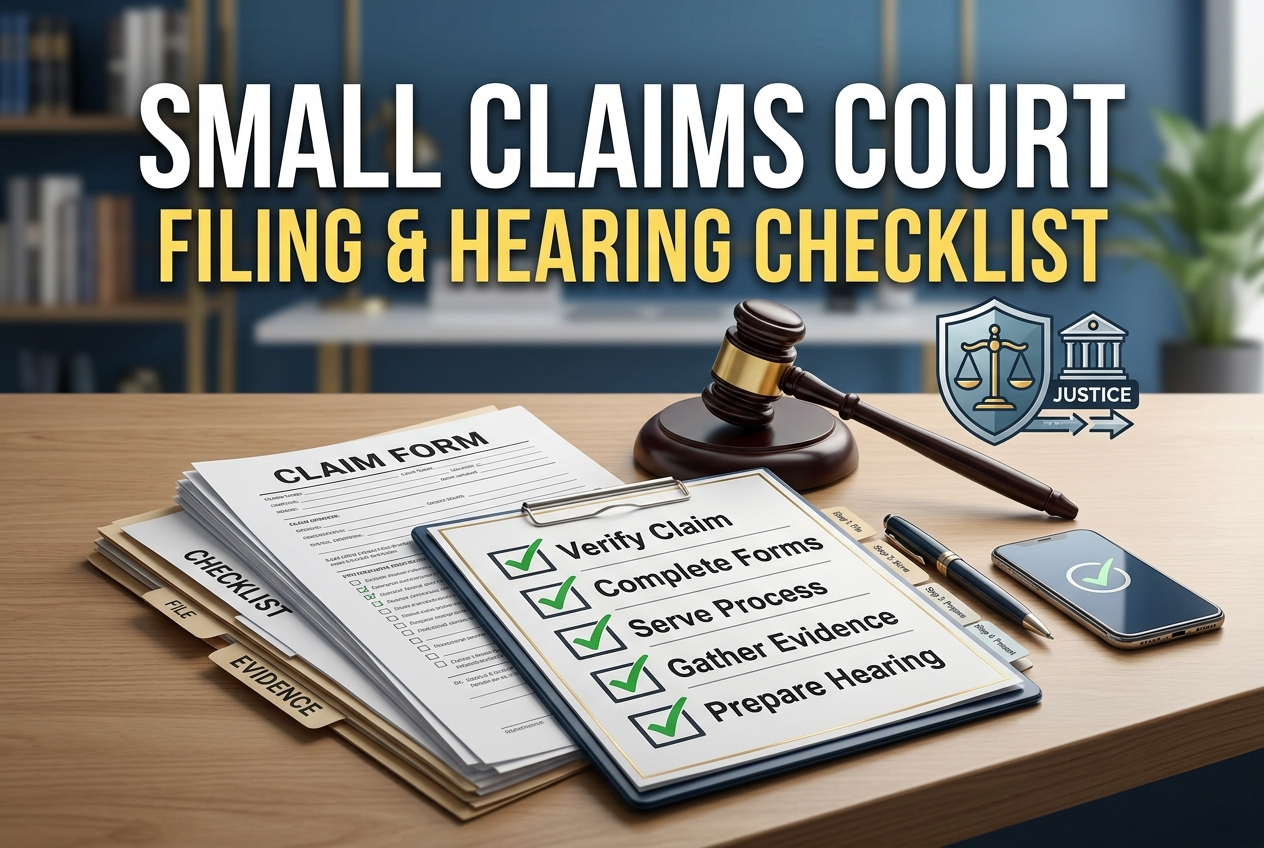
About this Capsule
Small claims court requires precise filing, serving, and preparation steps to ensure your dispute is heard and decided fairly. You will work through verifying your claim’s eligibility, completing official service of process, preparing evidence and witnesses, and understanding court procedures. By following these steps, you finish ready to present your case effectively and pursue collection if you win.
4 essential takes on small claims court
Practical steps for small claims court success.
Access to justice crisis and tech solution
Try asking: “Why should small claims courts adopt legal technology?”
Potential small claims court dispute triggers.
Judge's expertise on small claims court.
Try asking: “Who chaired the group revising small claims rules?”
Questions this capsule answers
Tap any question to get it answered inside the capsule, free.
Generic AI vs AI with This Capsule
Preview“Should I wait until closer to my court date to serve the defendant, or does timing of service actually matter for my case?”
Generic AI
“Yes—timing of service can matter a lot. In most cases, you should not wait until the last minute unless a lawyer familiar with your case tells you to.
Key reasons service timing matters:
- Courts have deadlines for service. After you file, many courts require the defendant to be served within a certain number of days. If you miss it, your case can be delayed or dismissed.
- Defendants must get minimum notice before the hearing/trial. If service happens too close to the court date, the judge may continue/postpone the hearing or refuse to proceed.
- You need proof of service. The court usually must receive a completed proof/affidavit of service before the hearing. Waiting can leave no time to fix mistakes.
- Service problems are common. The defendant may be hard to find, avoid service, or the process server may make an error. Serving earlier gives you time to correct ...”
This Capsule
“Do not wait until close to the court date. Timing of service can decide whether your case goes forward, gets continued, or gets dismissed.
Service matters for four reasons:
-
The court usually cannot hear the case unless the defendant was properly served.
If the defendant was not served, the court generally will not proceed to trial. -
There are minimum notice deadlines.
Many small claims courts require service at least 10–30 days before the hearing, depending on the location and method of service. For example, in California small claims, service is commonly required at least 15 days before the hearing if served in-county and 20 days if served out-of-county. Some substituted-service deadlines are longer. -
You usually must file proof of service before the hearing.
In California, for example, **Proof of Service Form SC-104 must be filed at...”
Related in Society

Planned Obsolescence: How Manufacturers Make Products Fail Faster
That phone slowing down or lightbulb dying on schedule may not be an accident. Manufacturers have a long record of deliberately shortening product lifespans to drive repeat sales, hiding it behind software restrictions and legal barriers to repair, while most people write the failures off as natural wear. Seeing the tactic clearly is the first step toward repairing what you own and demanding products built to last.

Water Fluoridation: Evidence, Exposure, and Consent
Fluoride in tap water is either one of public health's great wins or mass medication without consent, depending on who you ask. These sides weigh new neurotoxicity and IQ-loss evidence, total exposure from many sources, the 0.7 mg/L level debate, and why much of Europe rejected the practice. You can weigh the science against the ethics and reach your own view.

Nuclear Deterrence: Small Wars, Moral Limits, and Existential Risk
Nuclear weapons have kept great powers from all-out war while giving them cover to fight smaller conflicts beneath the threshold. The views wrestle with how to keep deterrence credible while honoring moral limits and controlling escalation, and whether failed disarmament makes elimination the only safe endpoint. Understand the paradox and the existential stakes behind every debate about the arsenal.