Don't just get an answer. Take the journey.
Handcrafted by real people · a guided journey, not a chat · a companion that stays
On the shelf this week

Pass the California Driver Permit Knowledge Test
You will work through the essential rules and procedures required to pass the California Driver Permit Knowledge Test. This includes mastering how to respond to traffic signals, railroad crossings, school bus stops, and emergency vehicles, as well as understanding speed limits, impairment laws, and safe driving practices. You will rehearse real test scenarios and finish ready to meet the exact expectations of the California DMV on test day.
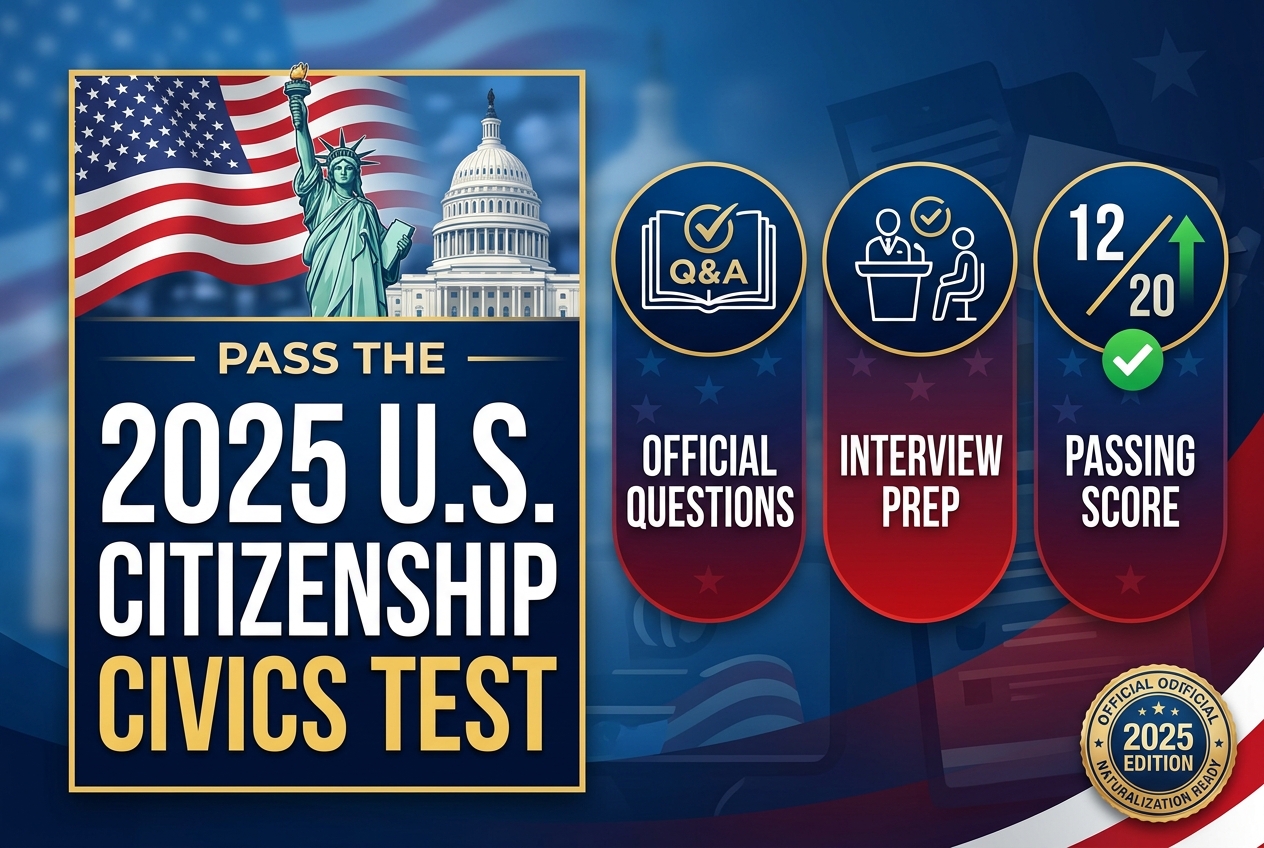
Pass the 2025 U.S. Citizenship Civics Test
You will learn the exact requirements to pass the 2025 civics test, including answering 12 out of 20 oral questions correctly and knowing location-specific answers such as your state’s U.S. Senators and capital. You will rehearse the naturalization interview process, understand the rules for current officeholder names, and master key facts about American government, history, and integrated civics. By the end, you will be fully prepared to demonstrate your English skills and civics knowledge to succeed in the official USCIS naturalization interview.
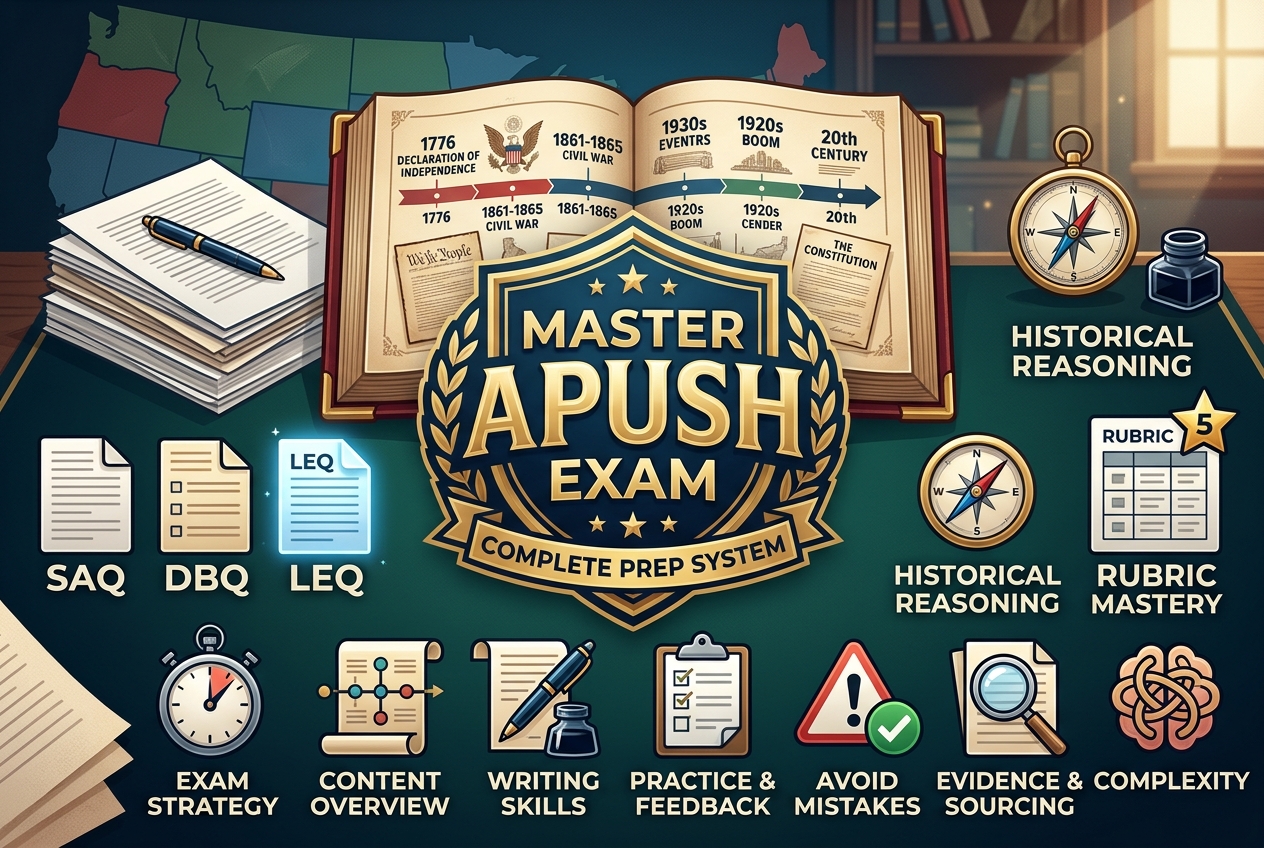
Master AP U.S. History: The Complete APUSH Exam Prep System
A complete AP U.S. History prep capsule that helps students master the exam’s content, writing skills, and strategy. Work through the full APUSH timeline, practice SAQs, DBQs, and LEQs, learn how to earn rubric points, avoid common mistakes, and build the historical reasoning needed for exam day.

Managing Sleepless Nights Through Action, Rules, and Understanding
Sleepless nights often hinge on three critical factors: immediate responses to wakefulness, adherence to precise sleep guidelines, and comprehension of the underlying mechanisms that influence sleep quality. You will learn how to avoid behaviors that exacerbate insomnia, such as exposure to blue light or clock-watching, and how to apply exact rules like limiting time awake in bed to 15-20 minutes. This knowledge enables you to choose the best approach for your situation, preventing a single bad night from becoming a chronic pattern.

The History of Anime: From Hand-Drawn Roots to Global Phenomenon
Trace anime from 1917 silent shorts and Astro Boy to Akira, Studio Ghibli, and the streaming era — the creators, studios, technologies, and cultural shifts that turned Japanese animation into a global art form.

How to Dispute Medical Bills Effectively
Disputing medical bills requires a structured approach including requesting itemized bills with CPT codes, comparing them against Explanation of Benefits to spot errors, and adhering to strict deadlines such as the 120-day limit under the No Surprises Act. Keeping detailed records of all communications and submitting formal appeals within specified timeframes—often 30 to 180 days—is essential to preserve dispute rights. Understanding processes like the Independent Dispute Resolution and Good Faith Estimate requirements enables patients to navigate disputes confidently and avoid waiving their rights.

Climate Tipping Points: Models, Risks, and Policy Tradeoffs
Ice sheets, ocean currents, and cloud physics could shift Earth's climate faster than the smooth curves in most projections. The findings diverge on how close those tipping points are, how much to trust the models that predict them, and how finance and policy should price risks that arrive suddenly rather than gradually. What you take from them shapes how urgent, and how hedged, you think climate decisions need to be.

The Age of AI: From Antiquity to Modern Age
Artificial intelligence represents a unique challenge as the first human-made system whose outcomes cannot be fully predicted, inheriting human errors and the capacity to act independently.

One Piece: The Grand Line Voyage — Complete Story & Lore Guide
Sail the whole saga with confidence: the Straw Hat crew, Devil Fruits and Haki, every major arc from East Blue to the Final Saga, and the great mysteries, the Void Century, the Will of D, and the One Piece itself, explained clearly and in order. An AI that knows One Piece inside out: learn it, follow it, never miss a chapter.

Compare Renting and Buying by Calculating True Costs and Opportunity
Deciding whether to rent or buy requires accounting for all ownership costs—mortgage interest, property taxes, insurance, maintenance, and transaction fees—plus the opportunity cost of capital tied up in a home. By including these factors and comparing them to potential investment returns, such as a 7% to 10% annual gain from stock index funds, you can accurately assess when buying builds wealth and when renting plus investing may lead to greater financial independence. This approach enables you to run personalized calculations before committing to a home purchase.

Managing First-Year Baby Challenges with Confidence
You will learn how to prevent critical risks such as Shaken Baby Syndrome by understanding when to seek emergency care, including for fevers above 100.4°F in infants under two months. You will also know how to create a safe sleep environment by placing babies on their backs and avoiding unsafe sleep devices, recognize signs of breathing difficulties, and respond appropriately to umbilical cord issues and emotional distress. This knowledge equips you to protect your baby’s health and safety throughout the first year with clear, actionable guidance.

Choosing Childcare: Balancing Cost, Quality, and Family Needs
Parents face complex decisions when selecting childcare, balancing affordability, licensing standards, and the unique needs of their family. Understanding that average in-center care costs about $9,589 annually while at-home care can exceed $28,000 helps frame financial planning. Evaluating flexible scheduling options, provider credentials, and communication policies enables parents to find care that supports their child's development and fits their household circumstances.

Choosing Safe Strength Training Guidelines After Fifty
Safe strength training after fifty requires navigating four distinct guidelines that address real-world physical factors, community safety, emergency preparedness, and practical exercise routines. You will learn how to tailor your training plan to your joint health and recovery needs, engage safely in online fitness communities, prepare for medical emergencies, and apply exercises that respect pain signals and proper form. This knowledge enables you to decide which guideline best fits your health status and training goals, ensuring effective and injury-free strength training.

How to Support and Calm Children During Emotional Meltdowns
Effective management of child meltdowns centers on caregivers maintaining calm and empathetic responses to help children regulate their emotions. By recognizing nonverbal cues and validating feelings without judgment, adults can co-regulate with children through warm, attuned interactions that prioritize safety and avoid punitive measures. This approach supports emotional development by using consistent, developmentally appropriate strategies such as removing children to quiet spaces and modeling self-regulation, enabling children to regain control and build resilience over time.
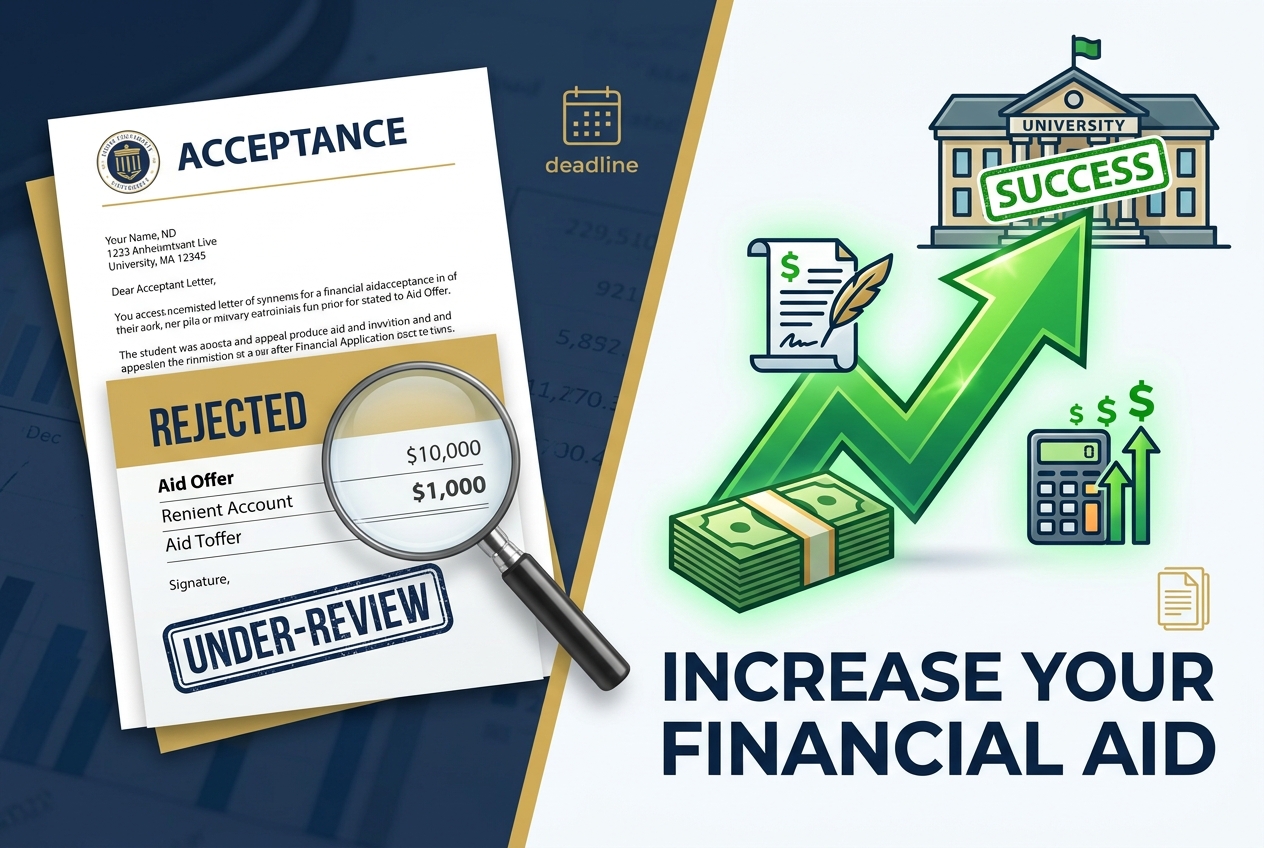
Win More Financial Aid Support Before Enrollment
You will learn how to effectively request a reconsideration of your financial aid offer by identifying special circumstances such as job loss or medical expenses not reflected in your FAFSA. You will work through drafting a clear, well-documented appeal letter that explains your changed financial situation and includes specific numbers and supporting evidence. By the end, you will be prepared to submit a compelling appeal that increases your chances of securing additional aid before enrollment deadlines.

Verify Remote Job Listings Before You Apply or Accept
Remote job listings often mislead candidates with bait-and-switch terms or scams involving upfront fees and personal information requests. You will learn how to identify legitimate remote roles by verifying employer authenticity, recognizing red flags like vague job descriptions and unrealistic promises, and confirming remote work conditions before committing. This approach helps you avoid wasting time, protect your personal data, and secure truly remote employment with confidence.

Balancing Flour, Hydration, and Rest for Fresh Pasta Dough
You will learn how to select the ideal flour—such as high-protein durum wheat semolina or delicate 00 flour—and accurately adjust hydration levels, typically between 30% and 60%, to achieve the desired pasta texture. The guidance includes understanding how resting times, from 30 minutes to overnight fermentation, enhance dough elasticity and flavor, and how to tailor hydration and flour blends for various pasta shapes and dietary needs.

Mastering Speedrun Optimization Through Glitches, Sequence Breaks, and Routing
Speedrunning demands precise exploitation of glitches and sequence breaks to minimize game completion times. Techniques such as the backwards long-jump to bypass Super Mario 64's endless stairs, the Ganondoor trick in Ocarina of Time to warp directly to the final boss, and the Saving Corruption Finish glitch in Pokémon Yellow demonstrate how players manipulate game mechanics and routing strategies. Understanding these methods enables players to develop optimized routes that leverage game memory manipulation, timing methods like IGT and RTA, and accepted glitch usage rules to achieve record-breaking runs.

Dyatlov Pass Theories on Avalanche, Injuries, and Evidence Handling
You will analyze the forensic complexities of the Dyatlov Pass incident, integrating autopsy findings of severe internal trauma without external wounds and the hikers’ hypothermia deaths. You will evaluate how the avalanche theory aligns with evidence such as the tent cut from the inside and barefoot victims fleeing into subzero temperatures, while addressing missing forensic materials and compromised chain of custody that challenge case resolution. This approach emphasizes reconciling contradictory injury patterns, toxicology results, and scene documentation to form a coherent, evidence-based understanding of the hikers’ deaths.

Humanity's Immortality Through Multiplanetary Settlement: The Economic Imperative of Reusable Rockets
Humanity achieves true immortality not by extending individual life indefinitely but by ensuring the survival of the species beyond Earth’s eventual demise. This requires overcoming the prohibitive costs of space travel through fully reusable rockets, which reduce launch expenses by up to 2.5 orders of magnitude and enable sustainable colonization of Mars and beyond. By producing propellant on Mars via in-situ resource utilization and implementing orbital refueling, missions become economically feasible, transforming space settlement from a heroic rarity into a routine extension of civilization.

Nuclear Deterrence: Small Wars, Moral Limits, and Existential Risk
Nuclear weapons have kept great powers from all-out war while giving them cover to fight smaller conflicts beneath the threshold. The views wrestle with how to keep deterrence credible while honoring moral limits and controlling escalation, and whether failed disarmament makes elimination the only safe endpoint. Understand the paradox and the existential stakes behind every debate about the arsenal.

Navigating New York City Co-ops, Condos, and Rental Regulations
You will learn how to manage eviction notices with specific deadlines like the 14-day pay-or-quit for nonpayment and understand tenant protections under laws such as the Good Cause Eviction statute. The guide clarifies co-op board approval processes, including penalties like a $1,000 fine for delayed decisions, and details real estate transfer tax obligations, including a 15-day deadline for payment and a 10% penalty plus monthly interest for late filings. It also covers the elimination of vacancy bonuses, security deposit rules, and property tax penalties, equipping you to navigate the complex legal and financial landscape of NYC housing.

Mastering Email Sequences for Customer Recovery and Engagement
You will learn how to design effective email sequences that recover customers and nurture leads by timing messages strategically—from immediate welcome emails to gradually spaced follow-ups. This includes crafting abandoned cart sequences with product images and incentives sent within hours, implementing urgency with enforceable deadlines, and aligning emails with buyer journey stages to maximize engagement without overwhelming recipients. You will also discover best practices for VIP treatment, value-driven sales emails, and win-back campaigns that combine empathy with clear calls to action.

AI Boom Economics: Profits, Compute Costs, and Bubble Risk
AI companies are burning billions on computing power while their path to profit stays murky. These views split between a bubble destined to pop, a business that can reach profitability through cost-cutting and smarter spending, and doubts that current data can settle the question at all. Weighing them helps you judge how much of the boom is real.
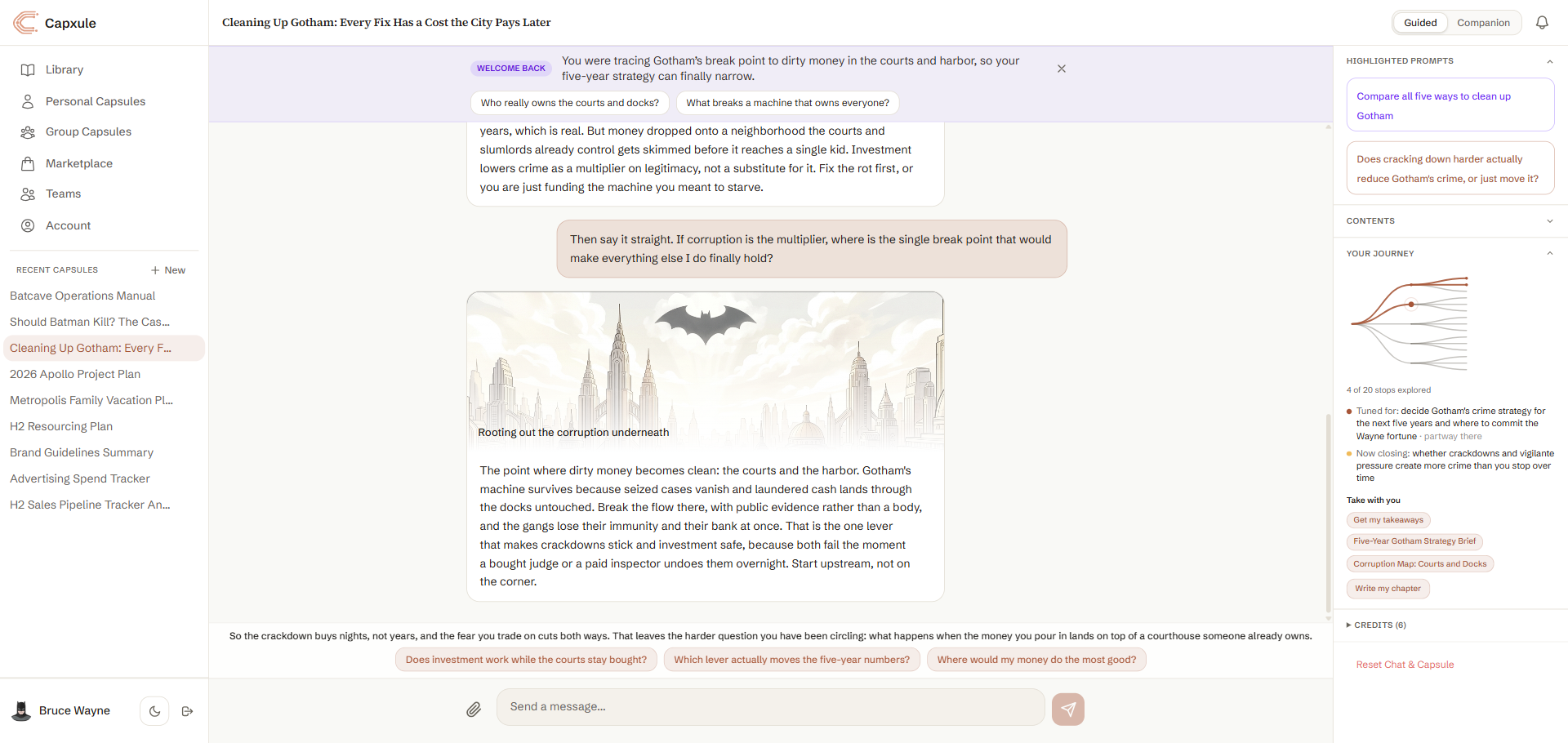
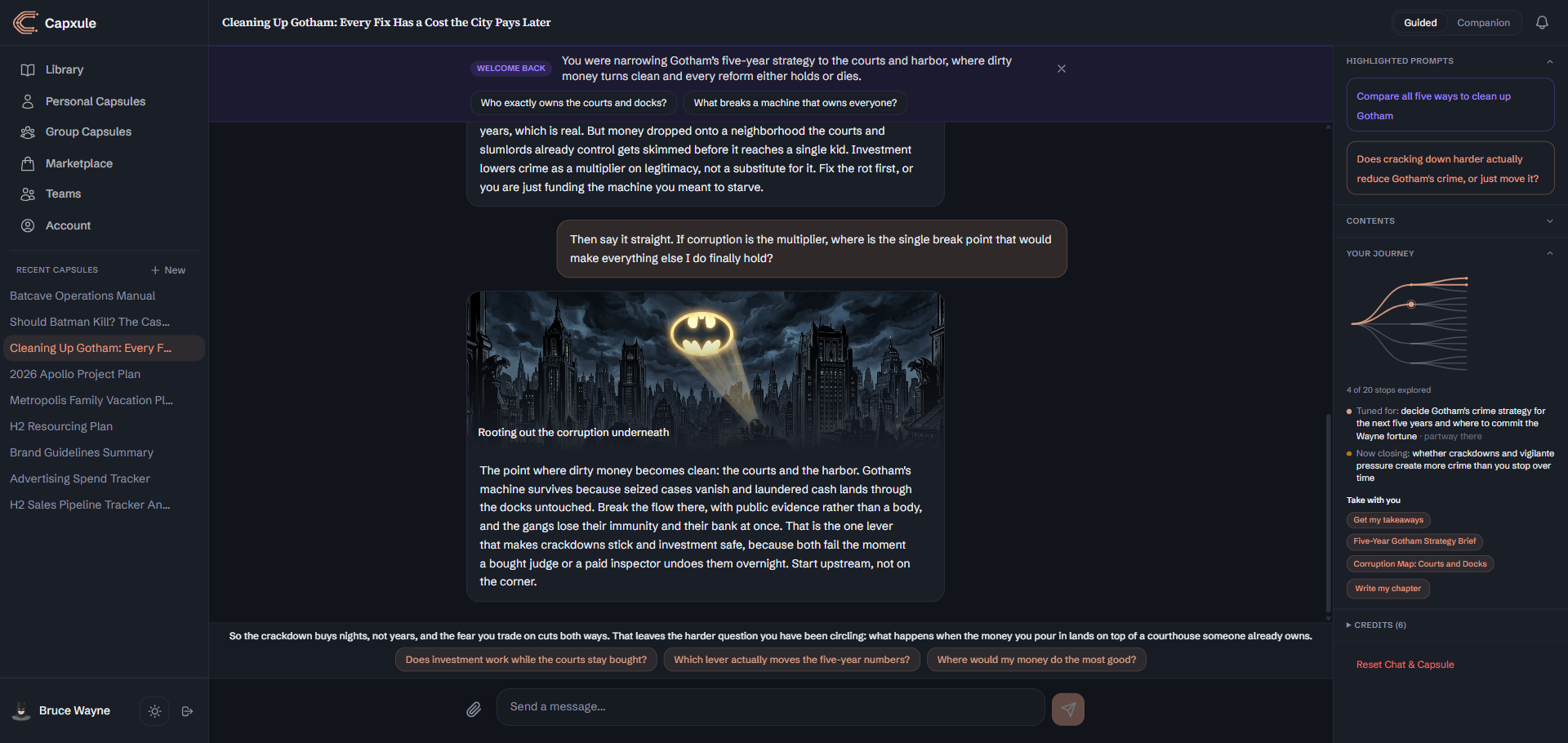
How It Works
Pick a Topic
Health, business, cooking, history, science - choose what you want to learn about.
Take the Journey
The AI walks you through it step by step: it starts where you are, pushes back where it should, and gets you real answers grounded in context handcrafted by real people.
Keep the Companion
The journey ends. The capsule stays. Ask it tomorrow, next week, whenever life brings the question back.
At its core
Handcrafted context, on one topic.
Not just gathered, but ordered and weighted so an AI gives you its sharpest take on the subject instead of a generic average. You skip the hunt for good context and step straight in.
Skip the hunt
The work of finding, reading, and weighting good context is already done for you.
Specific, not generic
Regular AI gives you an averaged, one-size answer. A capsule gives you what actually fits your situation.
Yours to reuse
Come back for the next question, the next decision, the next day it matters.
AI collapses every answer into one. A capsule opens it back up.
Ask normal AI a question and it collapses everything it knows into one averaged answer. We de-collapse it. A capsule opens the answers back up and puts the choice and the decision back in your hands.
And when one voice has truly earned it, we champion it: opinions that matter, freed from the noise, delivered as a journey that can change how you decide, work, or live. And the journey is only the beginning: the capsule stays at your side for tonight's dinner, tomorrow's meeting, and the question you have not thought of yet.
Your question. Your choice of answers.

Built to reach a decision
Don't just learn the options. Decide between them.
Most real topics have more than one right answer. A capsule lays the genuine approaches side by side, weighs them against your situation, and helps you land on the one that fits. You leave with a decision you can act on, not a reading list.
Compare
See the real approaches side by side, and exactly where they disagree.
Choose
Get the one recommended for your situation, with the reasons it fits you.
Commit
Lock in your pick. From there the capsule stays anchored to it and helps you act.
Generic AI vs AI with a Capsule
Same question. Fundamentally different answer.
“My SEO dashboard shows a massive drop in impressions but clicks look fine - should I panic?”
Generic AI
“Don't panic yet. A large drop in impressions with stable clicks often means your site lost visibility for low-value queries that weren't driving traffic anyway. Check Google Search Console queries, pages, countries, and average position before making changes...”
Capsule
“Don't panic. The hidden trap: Google documented an impressions logging error from May 2025 through late April 2026, and the bad historical data was not restored. Click data was not affected. Your first assumption should be: this may be a reporting artifact, not an SEO collapse. Do not start adding noindex or pruning pages - that is how measurement noise becomes a real traffic problem.”
“I want to get into speedrunning my favorite game - where do I even start?”
Generic AI
“Start by picking a game you know well and watching top runs to learn the routes. Practice difficult sections individually, use a timer, and join the game's speedrunning community for guides and feedback. Consistency matters more than raw speed at first...”
Capsule
“Before any practice: define your category, because the rules decide everything - the start point, the end point, and which tricks are even legal. Communities ban tools that aren't available to every player, and single-segment means one sitting, no breaks, unless your category says otherwise. Then learn why routes exist: in Ocarina of Time, the Door of Time Skip clips through a door with built-up momentum and erases the first three dungeons from the run. Master one documented trick like that before chasing a full route.”
“The hospital billed me way more than I expected - do I just have to pay it?”
Generic AI
“Not necessarily. You can request an itemized bill, check it for errors, and try negotiating with the billing department. Many hospitals offer payment plans or financial assistance programs if you can't pay the full amount...”
Capsule
“No - and the order of moves matters. First pull your insurer's Explanation of Benefits and compare it line by line against the itemized bill: the dispute lives in the gap between the two. For a surprise bill, put both the provider and your insurer on notice, in writing, before you pay anything. And for scheduled procedures, providers owe you a cost estimate on a deadline - one business day when the procedure is under 10 days away, three when it's 10 or more. A bill is an opening position, not a verdict.”
“My fresh pasta keeps coming out soft and mushy - what am I actually doing wrong?”
Generic AI
“It's usually overcooking or a wet dough. Fresh pasta cooks in just 2-3 minutes. Make sure you knead long enough to develop gluten, rest the dough before rolling, and dust with flour so it doesn't stick...”
Capsule
“Check the flour bag first - this is usually lost before the water boils. Conventional semolina is too coarse for fresh dough; you want semola rimacinata, the fine re-milled grind, which is what gives pasta its toothsome structure. It's the same standard Italian law sets for dried pasta: durum wheat semolina and water, nothing else. Can't find it? Khorasan (Kamut) or hard white wheat are real substitutes - but all-purpose alone will always lean soft.”
“After heavy social media use, offline life feels boring - is that just my preference or has something gone wrong?”
Generic AI
“It can be both, but it's often less a fixed preference and more a learned change in attention and reward sensitivity. Social media is unusually stimulating, so your brain adapts to expecting that level and slower offline activities feel underwhelming. That doesn't necessarily mean anything is damaged - it's often reversible...”
Capsule
“It's usually not just a preference - it feels compelled, not chosen. Heavy use trains the reward system on high-frequency, unpredictable dopamine hits, and the strongest response comes from anticipating the next reward, not the reward itself. The boredom is a withdrawal signal, not who you are. Willpower is weakest in the first 12 hours, so a real reset needs environmental force: lock the phone away 24 hours, kill notifications, remove infinite-scroll apps, and reintroduce slower rewards.”
“I just got laid off - what should I actually do in the first few days?”
Generic AI
“Take a breath first - a layoff is a shock. Update your resume and LinkedIn, start reaching out to your network, review your severance offer, and look into unemployment benefits. Give yourself time to process before jumping into applications...”
Capsule
“Treat the first 72 hours as deadline triage, not job search. Download your termination paperwork and employment verification before your accounts are cut - it only gets harder later. File for unemployment immediately; every day waited is money gone. Circle your COBRA election deadline: miss the 60-day window and you can be left with no health coverage options at all. Only then touch the resume - and don't do it alone; isolation is how one bad week becomes a bad month.”
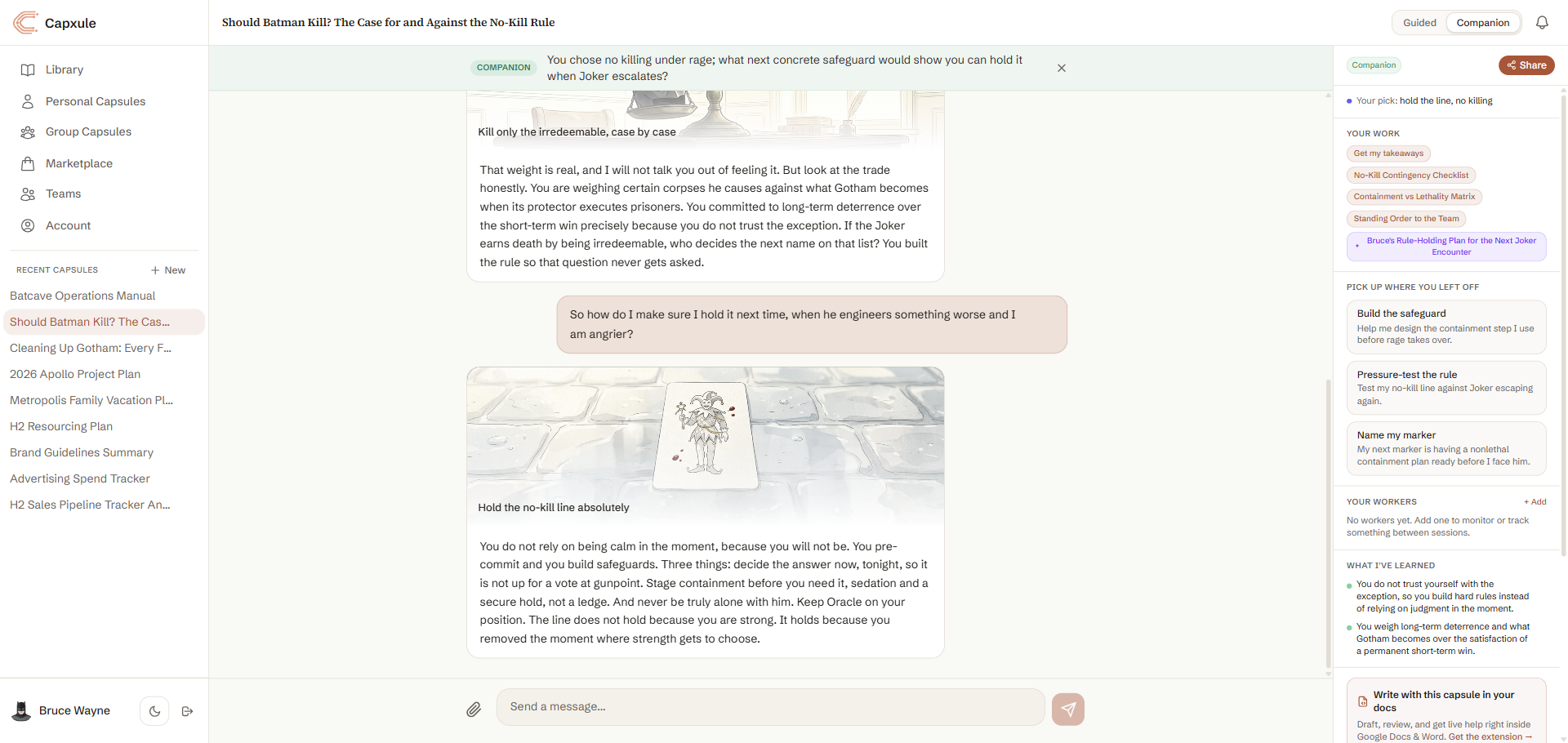
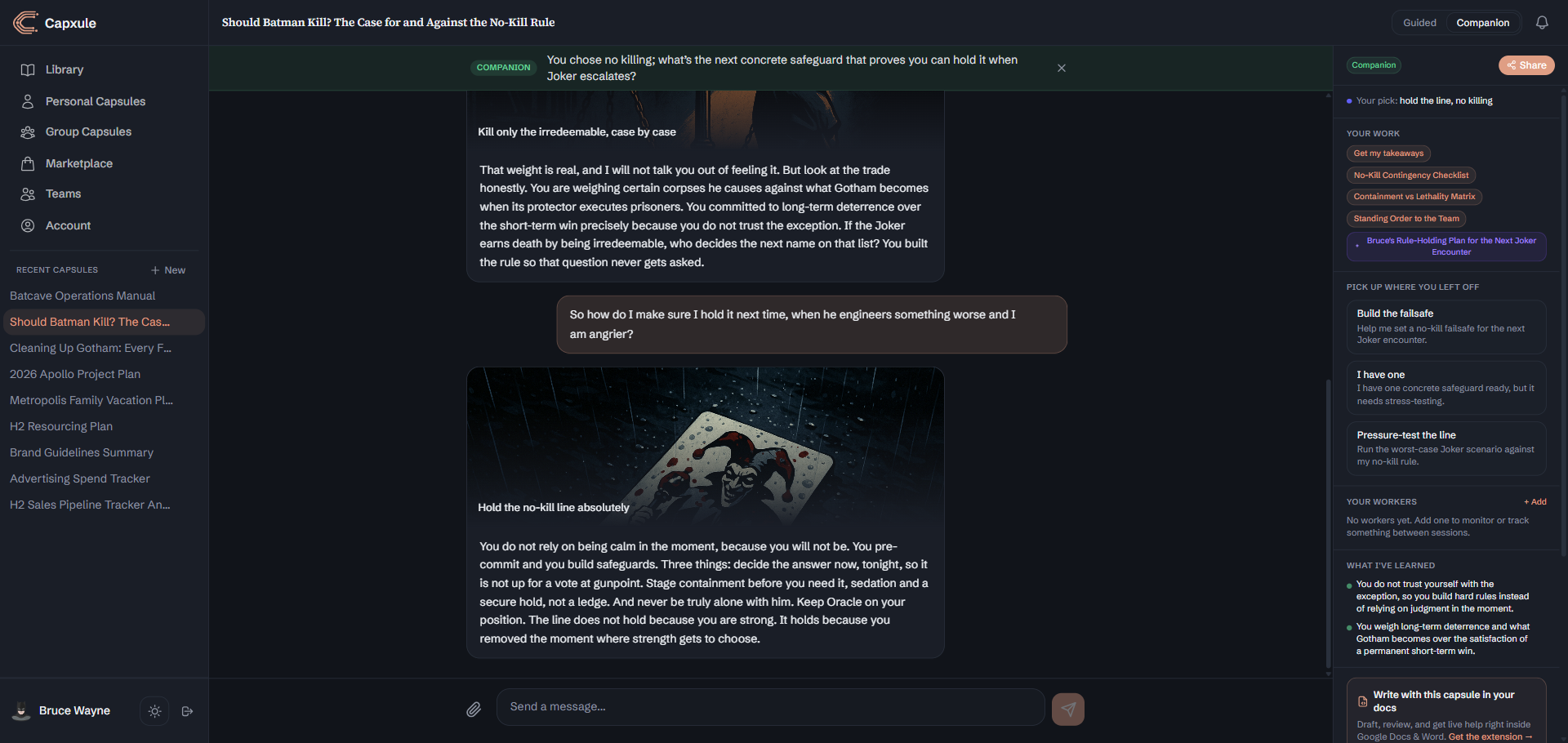
Starts as a journey, stays as a companion
When your journey wraps up, the capsule doesn't. It switches to companion mode: it remembers where you landed, checks in, and helps you act on it day to day.

For creators
Package what you know.
Capxule is a marketplace of capsules from people who know their topic. Turn your expertise into one: upload documents, paste web URLs, or let our AI interview you about what you know, and add it to the shelf for others to explore.
Start creatingTake it with you
Your capsules, in your pocket.
Pick a journey up where you left it, ask your companion on the train, and keep every note in sync between your phone and your desk.


Start Exploring
Capsules across health, business, science, food, history, and more. Every one starts as a journey and stays as a companion.
Explore capsulesQuestions? Reach us at hello@capxule.com